Key Takeaways
Post Cap Lights
- Best For: Perimeter lighting, visual interest
- Installation Difficulty: Easy-Moderate
- Power Source: Solar or Low-Voltage
Step/Stair Lights
- Best For: Safety, preventing falls
- Installation Difficulty: Moderate
- Power Source: Low-Voltage LED
Recessed Lights
- Best For: Subtle illumination, pathways
- Installation Difficulty: Moderate-Difficult
- Power Source: Low-Voltage LED
String Lights
- Best For: Ambiance, entertaining
- Installation Difficulty: Easy
- Power Source: Standard or Solar
Strip/Under-rail Lights
- Best For: Accent lighting, subtle glow
- Installation Difficulty: Moderate
- Power Source: Low-Voltage LED
Smart Lighting
- Best For: Customization, convenience
- Installation Difficulty: Moderate-Difficult
- Power Source: Low-Voltage LED
Getting Started with Deck Lighting
Your deck is more than just an outdoor space—it’s an extension of your home where memories are made, meals are shared, and relaxation happens naturally. But when the sun sets, an unlit deck becomes unusable at best and hazardous at worst. The right outdoor lighting transforms your deck from a daytime-only space into a 24-hour oasis that enhances both safety and beauty.
According to Fixr.com, “the national average cost for outdoor lighting installation ranges from $2,000 to $4,000, with most people paying around $3,000 for eight LED step lights and 12 hardscape lights installed around a pool area, including wiring and a new transformer.” While this represents a significant investment, the returns in terms of safety, aesthetics, and extended usability make deck lighting one of the most valuable additions to your outdoor living space.
The right lighting doesn’t just extend your time outdoors; it dramatically enhances your property’s curb appeal and value. Smart deck lighting significantly enhances outdoor spaces by improving safety, aesthetics, and functionality. Whether you choose simple LED strips or sophisticated color-changing options, proper lighting transforms your deck into an inviting environment for both daytime and nighttime enjoyment.
At Kounty Line Builders, we’ve helped numerous homeowners throughout Howard, Pennsylvania region transform their outdoor living spaces with expertly designed and installed deck lighting systems. This guide will walk you through everything you need to know about outdoor lighting for decks: from choosing the right fixtures to understanding installation options and getting inspired by creative design ideas.
Create Your Dream Outdoor Living Space
Looking to build a new deck or renovate your existing outdoor space? Proper lighting is just one aspect of great deck design.
Understanding Your Deck Lighting Options
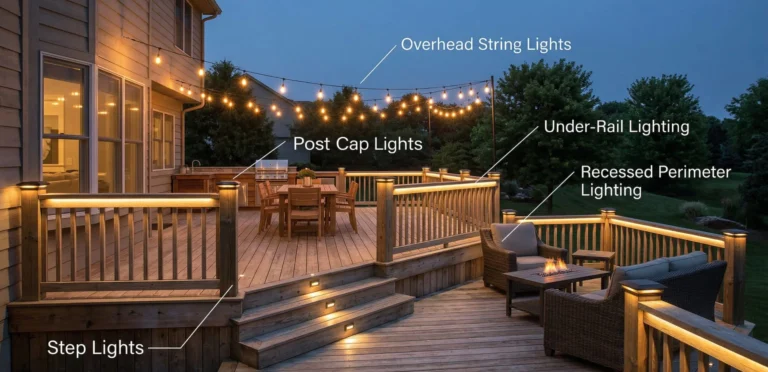
Deck lighting options include post cap lights for perimeter illumination, step lights for safety, recessed lights for pathways, under-rail lighting for subtle glow, accent lights for highlighting features, and string lights for ambiance. Each type serves specific functional and aesthetic purposes. Post caps protect railings while adding decoration, step lights prevent falls, recessed fixtures create clean integration, and strip lighting offers versatile installation options for railings, stairs, and features.
The world of deck lighting offers diverse options that serve various functional and aesthetic purposes. Let’s explore the main types of lighting you can incorporate into your deck design:
Post Cap and Rail Lighting
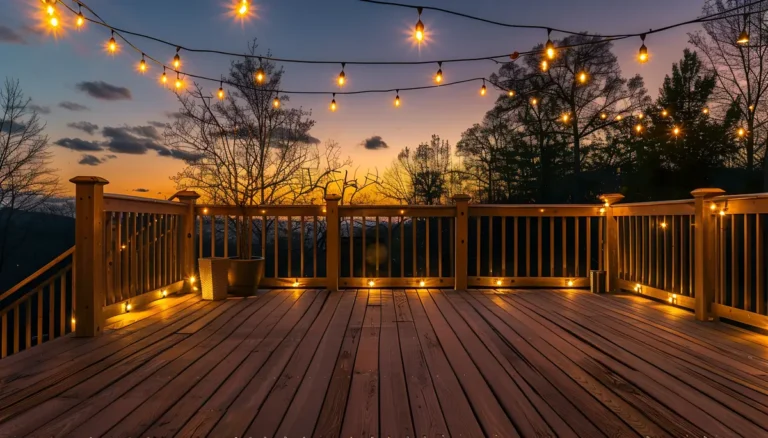
Post cap lights sit atop your deck railing posts, providing both decoration and functional lighting. Post cap lights serve the dual purpose of protecting railings from damaging debris while adding decorative detail during daylight hours and creating a lovely ambiance after dark.
Post cap lights come in various styles and finishes to complement your deck design. They typically provide a soft downward glow that illuminates the deck surface without creating harsh glare. These fixtures are available in both solar and low-voltage options, making them versatile for different deck setups.
Rail lighting, installed on or under your deck railings, adds another dimension to your lighting design. These fixtures create a subtle glow that outlines your deck’s perimeter, enhancing both safety and visual appeal.
Step and Stair Lighting for Safety
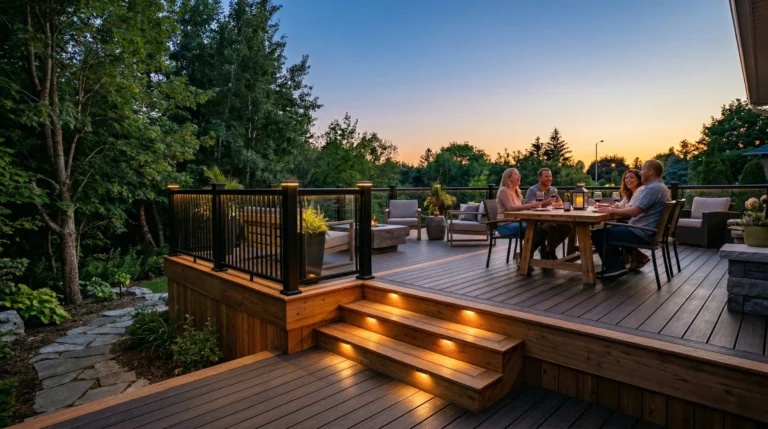
Step and stair lights are primarily functional and also add aesthetic value. LED lighting transforms decks into ideal evening entertainment spaces, providing both safe illumination and a pleasant environment for outdoor enjoyment.
These lights are typically installed on stair risers or along the edges of steps, illuminating the treads to prevent trips and falls. They’re especially important for decks with multiple levels or those used frequently for evening entertaining.
Recessed Deck Lighting
Recessed lights are installed flush with your deck surface, creating a clean, integrated look. Recessed lighting offers versatility for any space size and design, including covered patios. Their direct installation within surfaces provides protection from weather elements and minimizes maintenance requirements.
These lights are ideal for illuminating walkways across your deck or creating a subtle perimeter outline. Because they’re installed directly into the deck boards, they’re virtually invisible during the day but provide effective illumination at night without creating trip hazards.
Under-Rail and Strip Lighting
Under-rail lighting consists of LED strips installed beneath your deck railings. These create a subtle, atmospheric glow that washes down the deck boards or highlights decorative railing features.
The versatility of strip lighting allows for installation in numerous locations: under benches, along stairs, beneath railings, or around features like outdoor kitchens or bar areas. Recessed deck lighting delivers both safety and style, eliminating concerns about missed steps or collisions with furniture and plants.
Accent and Ambient Lighting Options
Accent lighting helps highlight specific features of your deck or surrounding landscape. Possible locations for accent lighting are spotlights for architectural elements, garden features, or water features near your deck.
Ambient lighting creates an overall mood and atmosphere. This category includes softer, diffused lighting options that provide general illumination without harsh brightness.
String and Decorative Lighting
String lights have become increasingly popular for deck spaces. They create a festive, inviting atmosphere and can be easily installed without extensive electrical work. Proper deck lighting is essential for nighttime outdoor enjoyment, and permanent lighting installations occasionally benefit from supplementary illumination. String lights provide exactly that boost in ambient lighting that complements more functional fixtures.
Decorative lighting includes lanterns, tabletop lights, and other portable options that add character and additional light sources to your deck. These are particularly useful for special occasions when you need to adjust your lighting setup for different activities.
Safety First: Deck Lighting Statistics
Research shows that every 100-lux increase in average lighting—such as upgrading deck lights—can reduce fall risk by around 9%–10%. In some settings, switching to brighter LED lighting has led to up to a 43% decrease in falls among residents”
LED vs. Solar: Choosing the Right Power Source
When choosing deck lighting power sources, low-voltage LED systems offer superior brightness, consistency, and longevity, using 75% less energy than traditional lighting with 50,000+ hour lifespans. Solar lighting provides wire-free installation and zero operating costs but delivers less consistent performance depending on weather and seasons. Consider initial costs, energy efficiency, and durability factors when deciding. LED systems have higher upfront costs but minimal electricity use, while solar fixtures need more frequent replacement.
When planning your deck lighting system, one of the most important decisions you’ll make is selecting the power source. The two primary options are low-voltage LED systems and solar-powered fixtures. Each has distinct advantages and considerations.
Benefits of Low-Voltage LED Lighting
Low-voltage LED lighting has become the gold standard for deck lighting installations. According to VOLT Lighting, “LEDs use at least 75% less energy and last 25 times longer than incandescent lighting.” This remarkable efficiency translates to significant energy savings over time.
LED lights also offer exceptional brightness and consistency. Unlike solar options, they provide the same level of illumination regardless of weather conditions or season. This reliability makes them ideal for primary safety lighting like stair and path lights where consistent performance is crucial.
Another advantage of low-voltage LED systems is their longevity. Quality LED fixtures can last up to 50,000 hours or more—translating to over a decade of use with normal evening operation. This long lifespan means fewer replacements and maintenance issues.
Low-voltage lighting systems are exceptionally DIY-friendly, with thin wiring that easily conceals on or beneath deck structures. While installation requires some planning and wiring work, the 12-volt current used in these systems is safer than standard household electricity.
Weather Resistance and Durability Factors
Outdoor lighting must withstand challenging conditions, from rainstorms and snow to temperature extremes and UV exposure. When selecting fixtures, look for proper weatherproofing ratings. Lights with an IP67 rating or higher provide the necessary weatherproofing to withstand harsh outdoor conditions and ensure long-term durability.
The IP (Ingress Protection) rating indicates resistance to solid objects and liquids. For deck lighting, look for ratings of at least IP65, which provides protection against dust and water jets. For areas with severe weather or fixtures near water features, consider IP67 or higher, which indicates protection against temporary immersion.
Material quality significantly impacts longevity. Brass, copper, and high-grade aluminum fixtures offer superior durability compared to plastic options. While metal fixtures cost more initially, their longevity makes them more economical over time.
Energy Efficiency and Cost Considerations
When evaluating the total cost of deck lighting, consider both initial installation and long-term operation. Low-voltage LED systems have higher upfront costs—including fixtures, transformers, wiring, and potentially professional installation. However, their exceptional energy efficiency means minimal impact on your electricity bill.
Deck lighting significantly enhances home exterior aesthetics while creating an inviting atmosphere suitable for both social gatherings and intimate evenings. The value added to your outdoor living experience often justifies the investment in a quality system.
Solar lighting has lower initial costs in most cases, especially when considering installation, since no wiring is required. The ongoing operation cost is zero, as they draw no electricity from your home. As a rule, solar fixtures need replacement more frequently than quality low-voltage LEDs, which offsets some of these savings over time.
Solar-Powered Deck Lighting: Pros and Cons
Solar deck lighting offers simplicity and environmental benefits that make it appealing for many homeowners. The most obvious advantage is that solar lights require no wiring, transformers, or electrical connections. This makes installation incredibly straightforward—often as simple as mounting the fixture and letting the sun do the rest.
Solar deck lighting provides a superb, environmentally friendly solution for both new and existing decks, eliminating concerns about wire concealment and power source connections. This wire-free operation makes solar lights particularly suitable for existing decks where running new wiring might be challenging.
The environmental benefits are significant as well. Solar lights produce zero emissions during operation and use renewable energy, making them the greenest lighting option available. They also add nothing to your electricity bill, regardless of how many fixtures you install.
However, solar lighting does have limitations. The most significant drawback is inconsistent performance based on weather conditions and seasonal changes. As a rule, solar fixtures do not fully charge during cloudy days or winter months with limited sunlight, which causes dimmer illumination or shorter operating times.
Solar lights typically produce less brightness than their wired counterparts. While technology continues to improve, most solar fixtures still do not match the intensity and consistency of low-voltage LED systems.
Selecting the Right Brightness
For deck lighting, balance is key. Too bright, and you’ll create harsh glare; too dim, and you’ll compromise safety. For ambient lighting, aim for 20-40 lumens per square foot. For task areas like outdoor kitchens, increase to 70-100 lumens per square foot. Step lights should provide at least 12-15 lumens per stair.
Smart Lighting Technology for Modern Decks
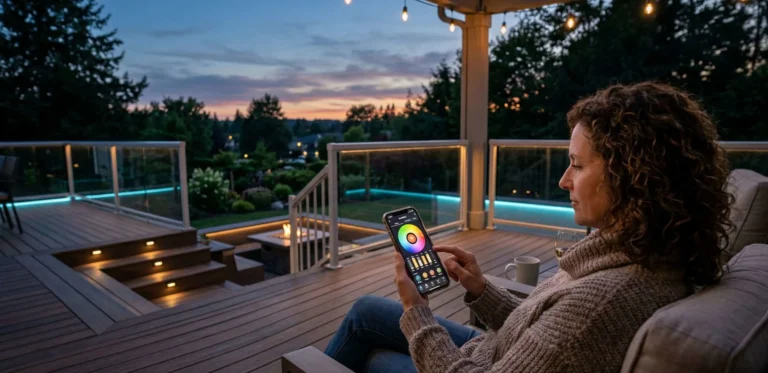
Smart deck lighting systems offer unprecedented control through smartphone apps, allowing remote adjustment of brightness, color, and timing. Advanced automation enables scheduled activation at sunset, personalized lighting scenes for different occasions, and integration with motion sensors for pathways. RGB technology produces virtually any color for creative designs, while dimming capabilities provide precise ambiance control. Many systems integrate with broader home automation platforms like HomeKit or SmartThings for synchronized indoor/outdoor environments.
The lighting technology landscape has evolved dramatically in recent years, with smart systems now offering unprecedented control and customization options for your deck lighting. These advanced systems will transform how you use and enjoy your outdoor space.
App-Controlled Lighting Systems
Modern deck lighting systems now offer smartphone control capabilities that were unimaginable just a few years ago. App-controlled permanent outdoor lighting systems allow complete control and customization of exterior illumination through smartphone applications.
These app-controlled systems allow you to adjust your deck lighting from anywhere using your smartphone or tablet. You can turn lights on or off, dim them to the perfect brightness, or even change colors with compatible RGB fixtures—all without leaving your seat.
The convenience factor is significant, especially for entertainment. Imagine adjusting the lighting atmosphere throughout an evening gathering without disrupting your guests or conversation. Many systems also work with voice assistants like Alexa, Google Assistant, or Siri, allowing hands-free control.
Programmable Timers and Automation
Smart lighting systems offer sophisticated scheduling capabilities that go far beyond basic timers. You can program your deck lights to automatically turn on at sunset and off at a specified time—or dawn—every day. Many systems also adjust automatically for seasonal changes in daylight hours.
More advanced automation allows for creating lighting scenes for different occasions. You might have a “Dinner Party” setting with brighter task lighting over dining areas, an “Evening Relaxation” scene with subtle ambient lighting, or a “Security” mode that mimics occupancy when you’re away.
Some systems can even integrate with motion sensors, automatically brightening pathways when someone approaches or triggering security lighting when movement is detected in normally vacant areas.
Color-Changing and Dimmable Options
RGB (Red-Green-Blue) and RGBW (Red-Green-Blue-White) LED technology has made color-changing lighting accessible and affordable for residential deck applications. These systems can produce virtually any color in the spectrum, allowing for creative lighting designs and special occasion themes.
Color temperature adjustability is another valuable feature in modern deck lighting. Color temperature adjustability provides the flexibility to shift from the cozy, intimate atmosphere of warm white light (2700-3000K) to the clearer visibility of cooler white light (4000-5000K) for tasks or security.
Dimming capabilities allow for precise control over brightness levels. Rather than the binary on/off options of traditional lighting, smart systems offer granular adjustment to create the perfect ambiance for any activity or time of night.
Integration with Home Automation Systems
For homeowners with existing smart home setups, deck lighting integrates into broader home automation systems. This integration creates seamless control across indoor and outdoor environments and enables more sophisticated automation.
Integration possibilities include:
- Coordinating deck lighting with indoor lighting for consistent ambiance throughout your home
- Linking lights with security systems to activate automatically during alerts
- Connecting with weather apps to adjust lighting during inclement weather
- Integrating with entertainment systems for synchronized lighting effects during outdoor movie nights or music
Many smart lighting systems work with popular platforms like HomeKit, SmartThings, or Hubitat, allowing for centralized control and complex automation routines that respond to multiple triggers and conditions.
Electrical Safety Reminder
Always follow manufacturer guidelines for outdoor lighting installation. Use only UL-listed products designed for outdoor use, ensure proper grounding, and use GFCI-protected outlets for all deck lighting. Consider consulting with a licensed electrician for complex installations.
Planning Your Deck Lighting Design
Effective deck lighting design balances functionality with aesthetics. Assess your deck’s primary use to determine task, ambient, and accent lighting needs. Create distinct zones for flexible control across cooking, dining, and lounging areas. Consider color temperature—warm light (2700-3000K) creates inviting atmospheres while cooler tones (4000K+) improve task visibility. Install appropriate brightness levels: 30-50 lumens per foot for pathways, 20-40 for seating areas, and 70+ for task areas like grilling stations.
Creating an effective deck lighting plan requires careful consideration of your space, needs, and aesthetic preferences. A thoughtful approach will ensure your lighting enhances both the functionality and beauty of your deck.
Creating Lighting Zones and Layers
Professional lighting designers think in terms of layers and zones—an approach you can adapt for your deck. Consider dividing your lighting plan into three key layers:
- Task lighting: Focused, brighter light for specific activities like cooking, dining, or reading
- Ambient lighting: General illumination that sets the overall mood and provides basic visibility
- Accent lighting: Decorative lighting that highlights architectural features or creates visual interest
Creating distinct lighting zones allows for flexible use of your deck. You might have a brightly lit cooking area near an outdoor kitchen, a moderately lit dining section, and a softly illuminated lounge space—all controllable independently to suit different occasions.
This zoned approach is particularly valuable with smart lighting systems that allow for scene programming. You can create preset configurations for different activities or times of day with a single tap.
Considering Color Temperature and Brightness
Color temperature dramatically affects the mood and functionality of your deck lighting. Measured in Kelvins (K), this spectrum ranges from warm yellowish light (2700K) to cool bluish light (5000K+).
For most deck applications, warmer color temperatures (2700K-3000K) create a more inviting, relaxing atmosphere similar to traditional incandescent lighting. This warmer light is particularly effective for entertaining spaces and lounging areas.
Cooler temperatures (4000K+) provide clearer visibility and are appropriate for task-focused areas like outdoor kitchens or for security lighting. However, these cooler tones can feel clinical or harsh in relaxation spaces.
Brightness needs vary throughout your deck space. Pathways and stairs typically require 30-50 lumens per linear foot for safety. Ambient lighting for seating areas works well at 20-40 lumens per square foot, while task areas like grilling stations require 70+ lumens per square foot.
Dimmable systems enable you to install lighting capable of higher output but operate it at lower brightness for normal use, providing flexibility for different activities and times of day.
Assessing Your Deck's Unique Needs
Begin by evaluating how you use your deck. Do you primarily entertain guests, use it for family dinners, or is it more of a quiet relaxation space? Different activities call for different lighting approaches. A dining area benefits from more direct task lighting, while lounge spaces are better served by softer, ambient illumination.
Consider the physical characteristics of your deck as well. Multiple levels require careful attention to stair lighting for safety. Built-in features like benches, planters, or pergolas offer opportunities for creative lighting integration. The material of your deck may also influence fixture selection—some mounting styles work better with specific decking materials.
Safety should be a primary concern in your assessment. Identify potential hazard areas like stairs, level changes, or edges without railings that would benefit from additional illumination. Creative lighting systems are the most effective method for showcasing and enhancing deck areas. But functionality must come before purely decorative considerations.
Balancing Functional and Aesthetic Lighting
The most successful deck lighting designs balance practical needs with aesthetic goals. Safety lighting doesn’t have to be utilitarian—recessed step lights can be both highly functional and visually attractive. Similarly, decorative fixtures can contribute meaningfully to overall visibility.
Consider the visual impact of your lighting both when viewed from on the deck and from inside your home or yard. Well-designed deck lighting enhances your home’s appearance from multiple perspectives.
The landscape surrounding your deck should influence your lighting choices as well. If your deck overlooks a beautiful view, avoid bright lighting that creates reflections on windows or glass doors that would obscure that view. In wooded settings, softer lighting preserves the natural ambiance while providing necessary visibility.
Energy Saving Strategy
To maximize energy efficiency, organize your deck lighting on separate circuits with independent controls. This allows you to use only the lighting you need at any given time rather than an all-or-nothing approach. Pairing LED fixtures with dimmers, timers, or motion sensors reduces energy usage by up to an additional 40%.
Installation Guide: DIY or Professional?
Deck lighting installation ranges from simple DIY projects to complex systems requiring professional expertise. Low-voltage systems use safer 12V power, making them suitable for homeowners with basic skills. A complete system requires fixtures, transformer, cables, connectors, and controls. DIY installation typically takes a weekend, following steps from planning layout to concealing wiring. Common mistakes include underestimating cable length, inadequate transformer capacity, and improper connections. Consider professional installation for complex systems, home automation integration, or electrical modifications.
Installing deck lighting ranges from simple DIY projects to complex systems requiring professional expertise. Understanding the basics helps you make informed decisions about what you can tackle yourself and when to call in the experts.
Required Components for a Complete System
A complete low-voltage deck lighting system typically includes these components:
- Lighting fixtures: The visible elements that produce light (post caps, step lights, etc.)
- Transformer: Converts standard 120V household electricity to safer 12V power
- Cables and wiring: Carries electricity from the transformer to each fixture
- Connectors: Securely join wires and cables throughout the system
- Controls: Switches, timers, photocells, or smart controllers that operate the system
- Mounting hardware: Brackets, screws, and other components to secure fixtures
Low voltage lighting systems are sufficiently safe and simple for most homeowners to install as DIY projects. The 12-volt current used in these systems poses minimal shock risk compared to standard household electricity, making DIY installation feasible for those with basic tools and skills.
For solar lighting, the component list is much simpler: just the fixtures themselves, plus any mounting hardware they require. No wiring, transformers, or external power sources are needed.
Step-by-Step DIY Installation Overview
If you’re considering installing low-voltage deck lighting yourself, here’s a simplified overview of the process:
- Plan your layout: Determine fixture locations and sketch a wiring diagram
- Mount the transformer: Install near a GFCI-protected outlet, typically 1-2 feet above ground level
- Run the main cable: Lay out the primary low-voltage cable along your planned route
- Install fixtures: Mount lights to posts, stairs, or other locations according to your plan
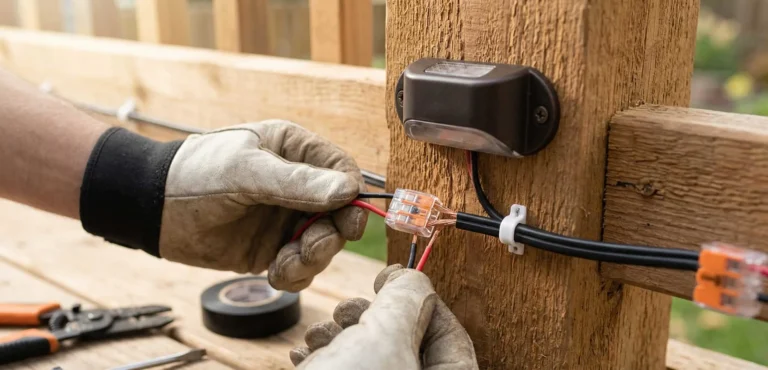
- Connect fixtures to the cable: Use weatherproof connectors to join fixture wires to the main cable
- Install any controls: Set up timers, photocells, or smart controllers
- Test the system: Verify all fixtures work properly before finalizing installation
- Conceal wiring: Hide cables under deck boards, inside railing posts, or by shallow burial
For most decks, this process takes a weekend to complete, depending on the system’s complexity and your experience level. Many manufacturers offer complete kits with detailed instructions for DIY installation.
When to Call a Professional
While many deck lighting projects are suitable for DIY installation, certain situations warrant professional assistance:
- Complex systems with numerous fixtures or zones
- Integration with existing landscape lighting or home automation
- Installations requiring new electrical outlets or service upgrades
- Custom lighting designs with specialized fixtures or effects
- Projects on very large or multi-level decks
- Any work that requires modifying your home’s electrical system leading up to the transformer
Professional installation typically adds $500-1,500 to project costs, depending on complexity, but includes benefits like warranty coverage, code compliance, and expert design assistance. Lights with an IP67 rating or higher provide the necessary weatherproofing to withstand harsh outdoor conditions and ensure long-term durability.” A professional ensures you select appropriate fixtures for your specific environment.
At Kounty Line Builders, we offer professional deck lighting installation services that ensure your system is installed safely, efficiently, and to the highest quality standards. Our experienced team can handle everything from simple post cap lighting to complex smart lighting systems with multiple zones and controls.
Common Installation Mistakes to Avoid
Even experienced DIYers can encounter challenges with deck lighting installation. Here are common pitfalls to avoid:
- Underestimating cable length: Always measure routes carefully and add 10-15% extra for unexpected changes
- Inadequate transformer capacity: Your transformer should handle at least 20% more wattage than your total fixture load
- Improper wire connections: Only use connectors rated for outdoor use with proper waterproofing
- Voltage drop: Using too thin a gauge wire or running cables too far causes distant fixtures to appear dimmer.
- Insufficient cable protection: Exposed cables can be damaged by weather, foot traffic, or garden tools
- Mounting fixtures incorrectly: Secure mounting prevents fixtures from shifting, tilting, or falling over time
Researching these common issues before starting your installation saves significant frustration and rework later.
Costs and Budgeting for Deck Lighting
Deck lighting costs vary widely based on quality and features. Fixtures range from $15-200 for post caps, $20-120 for step lights, and $5-30 per foot for LED strips. Additional components include transformers ($100-500), cables ($0.50-2.00/foot), and controllers ($30-300). Budget $500-1,500 for materials on average-sized decks, with premium systems reaching $2,000-5,000. Professional installation adds $500-1,500. Long-term costs favor LEDs, which operate 40,000+ hours and add only $10-30 annually to electricity bills. Well-designed lighting typically provides 50-150% ROI at resale.
Understanding the costs associated with deck lighting helps you budget appropriately and make informed decisions about your project scope. Let’s break down the expenses you can expect:
Average Costs for Materials and Fixtures
Deck lighting fixture costs vary widely based on quality, material, and features:
- Post cap lights: $15-200 per fixture (solar on low end, premium metal low-voltage on high end)
- Step lights: $20-120 per fixture
- Recessed deck lights: $15-80 per fixture
- LED strip lighting: $5-30 per foot, plus controllers
- String lights: $25-200 per string, depending on length and quality
- Spotlights/accent lights: $30-150 per fixture
Beyond the fixtures themselves, factor in these additional components:
- Transformer: $100-500, depending on capacity and features
- Cable: $0.50-2.00 per foot for low-voltage cable
- Controllers: $30-300 for timers, photocells, or smart controllers
- Connectors and accessories: $50-200 for a typical system
The Fixr.com article explains that, “hardwired lights are ideal for porch lights, garage lights, and other lighting attached to the house or garage. However, that depends on the wiring available because it costs $300 to $500 if it needs to be installed.”
For budget planning, expect material costs of $500-1,500 for a modest DIY system on an average-sized deck. More elaborate systems with premium fixtures or smart controls easily reach $2,000-5,000 in materials alone.
Installation Costs (DIY vs. Professional)
DIY installation eliminates labor costs but requires your time and effort. Beyond purchasing materials, the project requires renting or buying specialized tools like wire strippers, voltage testers, or cable trenchers.
Professional installation typically costs $50-100 per fixture plus base setup fees. For a complete system, labor usually adds $500-1,500 to the project total, depending on complexity and local labor rates.
Factors that increase professional installation costs include:
- Difficult access points or complex mounting locations
- Need for new electrical outlets or service upgrades
- Custom programming for smart lighting systems
- Installation on very large or multi-level decks
- Integration with existing lighting or automation systems
While DIY installation saves money, professional installation includes benefits like extended warranties, guaranteed code compliance, and ongoing support that provide value beyond the initial cost savings.
Long-Term Energy and Maintenance Costs
The operating costs of your deck lighting system depend primarily on the lighting technology you choose. LED systems are remarkably efficient—a typical deck lighting setup with 10-15 fixtures might add only $10-30 to your annual electricity bill when used 4-6 hours daily.
According to TriStar Electric, “some LED lights can operate for approximately 100,000 hours. Unlike traditional bulbs, LEDs gradually diminish over time, so you will always have advance notice before they go out.” This extended lifespan dramatically reduces maintenance costs compared to traditional lighting.
Solar systems eliminate electricity costs entirely but typically require more frequent fixture replacement—every 2-5 years for budget models, compared to 10+ years for quality LED systems. Battery replacement costs for solar fixtures should be factored into long-term maintenance budgets.
Maintenance requirements also vary by material and quality. Brass and copper fixtures develop a natural patina but rarely need replacement, while plastic fixtures may become brittle and require more frequent replacement, especially in harsh climates.
Return on Investment and Home Value Considerations
Well-designed deck lighting enhances your home’s value in several ways. It increases curb appeal for potential buyers, extends the functional hours of your outdoor living space, and addresses safety concerns that might otherwise be flagged during home inspections.
While exact ROI figures vary, real estate professionals typically cite landscape and deck lighting as providing a 50-150% return on investment at resale. Beyond the financial return, the daily enjoyment of a beautifully lit outdoor space represents significant lifestyle value for many homeowners.
For maximum ROI, focus on quality fixtures in key locations rather than numerous budget options throughout your deck. Professional-grade lighting with brass or copper construction often provides better long-term value despite higher initial costs.
Maintenance and Troubleshooting
Regular seasonal maintenance ensures reliable deck lighting performance. Spring tasks include cleaning fixtures, repairing winter damage, and repositioning shifted components. Fall maintenance involves clearing debris, checking connections, and adjusting timers for shorter daylight hours. When replacing components, match voltage, wattage, and color temperature specifications. Common troubleshooting steps address non-functioning lights (check power, connections, and voltage), dimming issues (inspect for voltage drop), and flickering (look for loose connections). Maximize system lifespan with weatherproof connectors, sheltered transformer placement, and regular inspections.
Proper maintenance ensures your deck lighting system performs reliably for years to come. Understanding basic troubleshooting saves you time and money when minor issues arise.
Seasonal Maintenance Tips
Regular seasonal maintenance keeps your deck lighting looking great and functioning properly:
Spring Maintenance:
- Clean all fixtures with a soft cloth and mild soap solution
- Check for and repair any winter damage to wiring or fixtures
- Trim back any vegetation that has grown to obstruct lights
- Adjust fixture positioning that may have shifted during freeze/thaw cycles
- Test system functionality and replace any failed bulbs or components
Fall Maintenance:
- Clear leaves and debris from fixtures and wiring paths
- Check transformer connections and housing for water intrusion
- Adjust timers and photocells for shorter daylight hours
- Inspect wire connections for corrosion or damage
- Consider adding protective covers to more vulnerable fixtures in harsh winter climates
For solar lighting, special attention to panel cleanliness is essential year-round. Even a thin layer of dust or pollen significantly reduces charging efficiency.
Troubleshooting Common Issues
When problems arise with your deck lighting, these troubleshooting steps identify and resolve many common issues:
Problem: No lights working
- Check that the transformer is plugged in and receiving power
- Verify that the GFCI outlet hasn’t tripped
- Check timer or photocell settings
- Inspect the transformer for blown fuses or tripped circuit breakers
- Test voltage output at the transformer terminals
Problem: Some lights not working
- Check bulb seating and connection in non-working fixtures
- Look for broken or disconnected wires leading to affected fixtures
- Test for voltage at the fixture location
- Inspect wire connections for corrosion or water intrusion
- Try a known working bulb in the non-functioning fixture
Problem: Dim or flickering lights
- Check for voltage drop issues (fixtures furthest from transformer appearing dimmer)
- Look for loose connections at fixtures or junction points
- Verify transformer output voltage
- Consider adding a larger gauge wire or secondary transformer for extensive systems
- Inspect for water infiltration in connections or fixture
Replacing Bulbs and Components
Even with long-lasting LED technology, eventual component replacement is inevitable. When replacing bulbs or fixtures, always match the specifications of the original components:
- Use the same voltage rating (typically 12V for low-voltage systems)
- Match the wattage or lumen output for consistent brightness
- Maintain the same color temperature (Kelvin rating) for visual consistency
- Ensure replacement parts have appropriate weather resistance ratings
Keep records of your lighting system components, including model numbers and specifications. This documentation simplifies the replacement process and ensures compatibility with your existing system.
For fixtures with integrated LEDs (without replaceable bulbs), you’ll need to replace the entire fixture when it fails. Quality fixtures often have modular designs that allow replacing just the LED module rather than the entire housing.
Weatherproofing and Extending System Life
The outdoor environment presents challenges for any electrical system. These practices help maximize the lifespan of your deck lighting:
- Use only weather-rated wire connectors with waterproof seals or silicone-filled caps
- Position the transformer in a sheltered location, ideally under an eave or deck
- Secure wiring to prevent movement that can stress connections over time
- Apply silicone dielectric grease to connection points for added moisture protection
- Install drip loops in wiring to prevent water from following cables into fixtures
- Use fixtures with full gaskets and drainage holes to prevent water accumulation
Regular inspection of these weatherproofing elements is key to preventing water-related failures, particularly in areas with heavy precipitation or humidity.
Design Inspiration: Deck Lighting Ideas
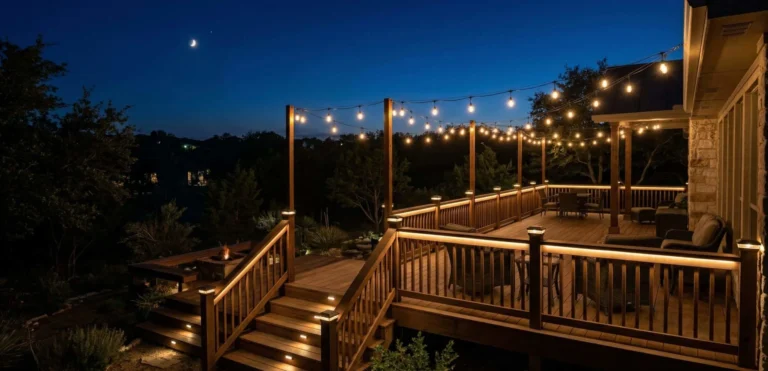
Modern deck lighting designs feature recessed fixtures, concealed LED strips, and clean lines with strategic negative space. Traditional approaches utilize lantern-style fixtures, warm light sources (2700-3000K), and patina-developing materials like copper. Smart systems adapt for special occasions with color-changing effects, programmable scenes, and integration with music systems. Architectural lighting techniques include uplighting distinctive railings, spotlighting landscape features, backlighting kitchen areas, and creating dimensional definition on multi-level decks through varied fixture types and brightness levels.
The right lighting design transforms your deck from an ordinary outdoor space into a stunning nighttime retreat. Here are some inspirational approaches to consider for your deck lighting project:
Minimalist and Modern Lighting Designs
Modern deck lighting emphasizes clean lines, hidden light sources, and subtle effects:
- Recessed lighting installed flush with deck surfaces creates a clean, uncluttered look
- LED strip lighting concealed under railings, benches, or steps provides indirect illumination
- Integrated fixtures that blend seamlessly with deck materials rather than standing out
- Monochromatic lighting schemes focused on whites and cool blues for contemporary appeal
- Strategic use of negative space, with unlit areas as deliberate as illuminated ones
This approach is particularly effective with contemporary deck designs featuring composite materials, metal railings, or minimalist furniture. The lighting complements rather than competes with the architectural elements.
Rustic and Traditional Lighting Approaches
For traditional or rustic deck designs, lighting that references classic forms creates a timeless aesthetic:
- Lantern-style fixtures that suggest historic oil lamps or gas lights
- Warm light sources exclusively in the 2700-3000K range to mimic firelight
- Copper and brass fixtures that develop natural patina over time
- Visible light sources that become decorative elements in themselves
- String lights with Edison-style bulbs for a vintage-inspired overhead canopy
This style pairs beautifully with natural wood decks, traditional architecture, and classic outdoor furniture. The warm glow creates an inviting atmosphere reminiscent of historic outdoor spaces. This is particularly true for rustic design approaches where the quality of light contributes significantly to the overall aesthetic.
Highlighting Architectural Features
Thoughtful lighting emphasizes the most attractive elements of your deck and surrounding landscape:
- Uplighting for distinctive railing designs or pergola structures
- Spotlights to highlight nearby landscaping features or water elements
- Backlighting for outdoor kitchen areas or built-in bars
- Grazing light along textured wall surfaces adjacent to the deck
- Shadow-casting techniques that project interesting patterns from deck features or nearby plants
Even a simple installation of string lights under a roof can dramatically transform the entire atmosphere of a deck space. This principle applies to all deck lighting—strategic placement of even simple fixtures can dramatically enhance architectural features.
For multi-level decks, lighting defines different functional zones while emphasizing the dimensional quality of the space. Consider using different fixture types or brightness levels for each level to create visual separation.
Creating Special Occasions with Lighting
Your deck lighting system is adaptable for special events and holidays:
- Color-changing LED systems that can be set to thematic colors for holidays or parties
- Temporary string lights or lanterns that supplement permanent lighting for larger gatherings
- Programmable lighting scenes for different types of events (dinner parties, cocktail hours, family game nights)
- Integration with music systems for synchronized lighting effects during celebrations
- Pathway lighting that is repositionable to accommodate different furniture arrangements.
Smart lighting systems excel at this adaptability, allowing you to transform your deck’s atmosphere with a few taps on your smartphone. Even without smart technology, strategic use of separate circuits and portable lighting achieves similar flexibility.
Conclusion
Outdoor lighting transforms your deck from a daytime-only space into a 24-hour extension of your home. Whether you’re entertaining guests, enjoying a family meal, or simply relaxing with a book in the evening breeze, proper lighting enhances safety, functionality, and beauty.
From energy-efficient LED systems to convenient smart controllers, today’s deck lighting options offer unprecedented flexibility and performance. By understanding the different types of fixtures, power sources, and design approaches, you can create a lighting plan that perfectly suits your unique deck and lifestyle.
At Kounty Line Builders, we specialize in creating custom decks with integrated lighting systems that enhance both form and function. Our team can help you design and implement a lighting solution that brings your outdoor vision to life—whether you’re building a new deck or upgrading an existing space.
Ready to illuminate your outdoor living experience? Contact Kounty Line Builders today at 814-482-1271 or email john@kountylinebuilders.com for a free consultation on your deck lighting project.

Free Design Resource
The Ultimate Guide to Custom Deck Design & Construction
Want to dive deeper before scheduling a consultation? Download our comprehensive whitepaper to explore material comparisons, safety codes, and expert layout tips.
- Material Comparison & Lifespans
- Safety Guidelines & Building Codes
- Budget Optimization Strategies
Frequently Asked Questions
How much does professional deck lighting installation cost?
Professional deck lighting installation typically costs between $500-1,500 in addition to materials, depending on system complexity and your location. Basic systems with 8-12 fixtures fall on the lower end, while elaborate multi-zone systems with smart controls trend toward the higher end. Always request detailed estimates that break down both material and labor costs.
Can I install deck lighting on an existing deck?
Yes, most deck lighting systems retrofit to existing decks. Low-voltage systems install with minimal disruption by running wires beneath the deck or concealing them along railings and joists. For decks where running wires is challenging, solar fixtures provide a wire-free alternative. Recessed lighting is more difficult to add to existing decks but still possible with the right tools.
How long do LED deck lights typically last?
Quality LED deck lights have an expected lifespan of 40,000-50,000 hours. With typical evening use of 4-6 hours daily, this translates to approximately 15-25 years of service. Actual lifespan varies based on environmental conditions, with fixtures exposed to extreme temperatures or moisture potentially having shorter lifespans. Most quality fixtures include warranties of 5-10 years.
Are solar deck lights bright enough to be effective?
Modern solar deck lights have improved significantly in brightness and reliability. Premium solar fixtures provide sufficient illumination for ambient lighting and marking pathways. However, they typically produce 30-60% less light than equivalent low-voltage fixtures and depend on sufficient daily sunlight to perform optimally. For critical safety lighting on stairs or primary task lighting, low-voltage systems generally provide more consistent performance.
What's the difference between low voltage and line voltage systems?
Low voltage systems operate at 12-24 volts and require a transformer to convert standard household electricity (120V). They’re safer to install, more energy-efficient, and offer more fixture options specifically designed for decks. Line voltage systems operate directly from household current (120V) without a transformer. They typically provide brighter illumination but require conduit for wiring, professional installation, and often permits. For most residential deck applications, low voltage systems offer the best balance of safety, flexibility, and performance.
Do I need an electrician to install deck lighting?
For low-voltage lighting systems, many homeowners can complete the installation themselves if they’re comfortable with basic tools and following wiring diagrams. The primary electrical work—connecting the transformer to a GFCI outlet—requires only that the transformer be plugged in. For systems requiring new electrical outlets, circuit modifications, or direct 120V connections, a licensed electrician is required to ensure code compliance and safety.
How can I protect my deck lights from weather damage?
Select fixtures with appropriate IP (Ingress Protection) ratings for your climate—IP65 or higher for most outdoor applications. Use waterproof wire connectors with silicone-filled caps for all connections. Install drip loops in wiring to prevent water from following cables into fixtures. Position transformers in sheltered locations protected from direct precipitation. Apply dielectric grease to connection points for additional moisture protection. Regularly inspect and clean fixtures, especially after severe weather events.
Can deck lights be left on all night?
Modern LED deck lighting operates safely continuously, but most homeowners use timers or smart controllers to turn lights off or dim them late at night. This approach saves energy, extends fixture lifespan, and prevents potential light pollution issues with neighbors. If security is a concern, consider motion-activated fixtures for key areas rather than keeping all lights at full brightness throughout the night.